
Category Archives: Nutrition

Avoiding GMOs

It is a common theme on this site and in practice that we stress the importance of feeding the body with the optimal fuel it needs and deserves.  One of the major stumbling blocks to this can be the consumption of the widespread GMO (genetically modified organism) or GE (genetically engineered) “foods.”

If you are still unfamiliar with or don’t understand what the big deal is, our best, natural fuel and medicine is being altered in a laboratory and then supplied to the masses.  This leaves us masses as the unknowing participants in a science experiment, with us being the Guinea pigs.

For a review on some of the hazards with human consumption of these foods click here: https://clarkechiropracticwellness.com/2013/12/04/whats-the-big-deal-with-gmos/

If you are looking to take a proactive step and limit your consumption of these “frankenfoods” laced with unwashable pesticides and herbicides, here are some tips to move you in the right direction:

Tip #1: Buy Organic

Certified organic products cannot intentionally include any GMO ingredients. Buy products labeled “100% organic,” “organic,” or “made with organic ingredients.” You can be doubly sure if the product also has a Non-GMO Project Verified Seal.

Tip #2: Look for “Non-GMO” Labels

Products that carry the Non-GMO Project Seal are independently verified to be in compliance with North America’s only third party standard for GMO avoidance, including testing of at-risk ingredients. The Non-GMO Project is a non-profit organization committed to providing consumers with clearly labeled and independently verified non-GMO choices. Look for dairy products labeled “No rBGH or rBST,” or “artificial hormone-free.”

Tip #3: Avoid At-Risk Ingredients

If it’s not labeled organic or verified non-GMO: Avoid products made with ingredients that might be derived from GMOs (see ingredient list below). The eight GM food crops are Corn, Soybeans, Canola, Cottonseed, Sugar Beets, Hawaiian Papaya (most) and a small amount of Zucchini and Yellow Squash.

Sugar

If a non-organic product made in North American lists “sugar” as an ingredient (and NOT pure cane sugar), then it is almost certainly a combination of sugar from both sugar cane and GM sugar beets.

Dairy

Products may be from cows injected with GM bovine growth hormone. Look for labels stating No rBGH, rBST, or artificial hormones.

Hidden GM Ingredients

Processed foods often have hidden GM sources (unless they are organic or declared non-GMO). The following are ingredients that may be made from GMOs.

Aspartame, also called
NutraSweet®, Equal Spoonful®,
Canderel®, BeneVia®, E951 AminoSweet®
baking powder
canola oil (rapeseed)
caramel color
cellulose
citric acid
cobalamin (Vit. B12)
colorose
condensed milk
confectioners sugar
corn flour
corn gluten
corn masa
corn meal
corn oil
corn sugar
corn syrup
cornstarch
cyclodextrin
cystein
dextrin
dextrose
diacetyl
diglyceride
Equal
food starch
fructose (any form)
glucose
glutamate
glutamic acid
gluten
glycerides
glycerin
glycerol
glycerol monooleate
glycine
hemicellulose
high fructose corn syrup (HFCS)
hydrogenated starch
hydrolyzed vegetable protein
inositol
inverse syrup
invert sugar
inversol
isoflavones
lactic acid
lecithin
leucine
lysine
malitol
malt
malt syrup
malt extract
maltodextrin
maltose
mannitol
methylcellulose
milk powder
milo starch
modified food starch
modified starch
mono and diglycerides
monosodium glutamate (MSG)
Nutrasweet
oleic acid
Phenylalanine
phytic acid
protein isolate
shoyu
sorbitol
soy flour
soy isolates
soy lecithin
soy milk
soy oil
soy protein
soy protein isolate
soy sauce
starch
stearic acid
sugar (unless cane)
tamari
tempeh
teriyaki marinade
textured vegetable protein
threonine
tocopherols (Vit E)
tofu
trehalose
triglyceride
vegetable fat
vegetable oil
Vitamin B12
Vitamin E
whey
whey powder
xanthan gum
The Time For Change is Here

Over the past few years I’ve had the privilege of speaking with a large number of diverse souls.  Due to my profession and personal interests, many of these conversations have been about health, namely that of the other party.

I will  usually hear a laundry list of complaints and presumed reasons for these issues.  Many times the individual will even verbally acknowledge the importance and impact that lifestyle changes could play in their life.

However, for whatever reason, the disconnect between talk and action remains and the path towards sickness and breakdown continues.  Knowledge without action is useless, and in this case, detrimental to your health.  Rather than going off and making this a psychoanalytical piece on why people don’t help themselves, let’s keep it positive and focus on how to get moving in the right direction.

First thing that needs to be done is to keep it real with yourself.  Take a good look in the mirror and decide what you really want.

Do you really want better health?

I would imagine so.  We all do.

Are you willing to WORK for it?

I mean really work. Not for show. Really work on yourself physically, mentally and spiritually.  This requires a discipline that keeps you in line and on track when no one else is looking. These are the times that the real changes occur.

What’s your goal?

Is it to kick the meds, normalize your levels, get rid of pain, drop some weight, do all you can to elongate this one shot at life?  Be clear on your goal as this will serve as your motivation to start and stick with it, especially early on in the process.

And be clear, this is a process. A marathon and not a sprint.  Living like no one else now so later on you can live; no, thrive like no one else.  Although drastic results are experienced by some early on, this is no quick fix. The “quick fix” mentality has got us in this mess to begin with by way of pill-popping per symptom and never really investigating or attempting to remedy why the symptom emerged in the first place.

Once you have your goal, investigate the means to achieving it.  What needs to be done and in what fashion in order not only achieve but sustain the achievement?

When it comes to healthcare, 90% of the time we are talking about lifestyle changes. Breaking the routine or the accustomed norms. This is where the “keeping it real” with yourself part comes into play.

Is your goal and the means by which to achieve that goal worth more to you than coming out of your comfort zone and breaking the habit?

Is it worth investing the time to plan and prep meals for the week ahead?

Will you follow through and set the alarm earlier or skip that 60 minutes of TV time in order to get that workout in?

Keep it real now. Do the benefits outweigh the costs? Although objectively speaking they do, ultimately this comes down to subjective perspective.

If you find that you are tired of the current state of affairs in your own life and you’ve decided enough is enough, the next step is to formulate a realistic, practical plan.  I find this to be another major stumbling block for people.  A sense of overwhelm sets in along with analyzation paralyzation.

The trick here is to get with your trusted healthcare provider and come up with a plan together.  Never be afraid to start small, as any change, any momentum in the right direction is better than sitting idle.  While sustained sweeping changes across the board would be ideal, studies show longer lasting changes occur more often as a product of smaller changes, cultivation over time.

A perfect example of this is my own personal anatomy of a “cheat meal.” This is that meal that diverges from the norm, an indulgence if you will. (In order to have a cheat meal you need to be sticking to clean eating for 80% of your meals or better.)

Through years of cultivation, the cheat meals have evolved from pizza and ice cream to a meal with gluten free rice, or a smoothie with organic peanut butter and heavy fruit. The latest “cheat” dessert has become a bowl of chia seeds with nuts, fruit, peanut butter and chocolate almond milk.

I say all this not to induce hunger, but to illustrate where you can wind up if you simply get started.  Make a change here and a change there. Implement another one as you learn more.  Once you get that ball rolling down the hill, it can be a powerful thing.

The other initial hurdle is that it is never a good time. Well, when it comes to core lifestyle changes there really never is an ideal time.

Again, they idea is to simply bite the bullet and get rolling.  In most cases it doesn’t have to be all or nothing all the time. Just do it.  Constantly talking the talk, while constantly finding excuses will leave you wondering where the time went and how on Earth things got so bad.

Believe in the power of lifestyle changes.  Resolution of every issue does not have to be another drug.  Every issue should not be blamed on genetics, making us all helpless victims.  Embrace the empowerment behind epigenetics and realize that lifestyle choices play a significant role as to whether or not certain genetic traits are expressed.  We’re talking about everything here from hair loss to cancer and auto immune diseases.

One shot.

One body.

That’s all we get.

The time is now to respect this opportunity and treat your body right.  Pick somewhere and get started today.  If you would like assistance on this journey, call us at anytime.  As we continue our own journey, we would love to be a part of yours.

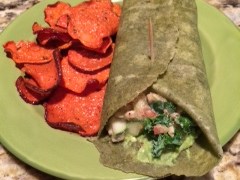
Wild Tuna Salad Wrap with Sweet Potato Chips

As my wife continues to walk around with another human constantly attached to her side, I find myself taking the initiative to step up the culinary skills on the weekend.  Essentially the weekend carries the same potential pitfalls as the weekdays as far as failing to plan equalling planning to fail.  Next thing you know you’ve stuffed yourself with an overpriced, subpar pizza and  are left with that lingering mental and physical food hangover.

While it is nice, almost necessary to indulge at times (and the weekend seems to be as good a time as any), I personally do not enjoy the aftermath of the “cheat meal,”  especially after eating clean and feeling great all week.  So, the weekend cooking has commenced and below is a cool, light labor day weekend dinner for your enjoyment.

INGREDIENTS:

1 lb. of fresh, WILD (not farmed) Tuna

(We prefer Atlantic Seafood in Port Canaveral for our fish, but Publix carries WILD fish as well. MAKE SURE YOU READ THE LABEL or ask.)

1 cucumber
1 tomato
1 onion
4 avocados

Kale or another super green (chard, spinach, etc.) to fill the wrap

2 sweet potatoes

Olive oil
Garlic salt
Parsley
Coconut oil

Additional seasoning of your choice

DIRECTIONS:
Warm pan (ceramic or cast iron preferred) on stove top (low-med range) and coat with coconut oil.

Preheat oven to 350.

Thinly slice two large sweet potatoes and distribute one layer cozily on a baking sheet.  Place in oven and let cook for approx. 20-30min.

(As I’ve noted on previous posts, neither of us use a cookbook or exact ingredients/times, so you’ll want to keep an eye on the chips and when they start to wrinkle/appear drier on top, it’s time to take them out and individually flip each one. That’s right, I said individually.  The thinner you slice the quicker they’ll cook so keep an eye on those puppies.)

While chips bake, dice the cucumber, tomato, and onion.

Cook tuna on pan to your liking.
(I prefer a more raw/seared tuna, but for the sake of the salad and my wife, a more even cook may be your best bet.)

Once tuna is done and cooled (don’t forget to check on the sweet potato chips) dice and mix in large bowl with the diced vegetables.

You can season the salad however you want.  I scanned the fridge and utilized an organic marinade bought from the Sunseed Co-Op for a past meal.

(The marinade is an easy way out, but delivered a nice cool, citrus taste to the salad. Traditionally when we think tuna, chicken or egg salad we think mayo, but we’re looking for a healthier choice here.  Instead of using the mayo, next time try mixing the salad with a healthier marinade (read the label) or some fresh guac.)

Mash up the 4 avocados to use as a spread and adhesive for the wrap.
(If you’re feeling real ambitious go all out and use some fresh homemade guacamole.)

Pull chips out of the oven and season in a large bowl with olive oil, fresh parsley and light garlic salt; or simply cinnamon depending on your mood.

Warm gluten free wrap briefly (again, our local co-op had a nice selection) in oven and fill with a layer of avocado spread, kale and tuna salad.

Serve with your chips and enjoy.

Tuna wrap

Are You Unknowingly Depleting Your Vitamins and Minerals?

For one reason or another, millions of Americans partake in a daily dosing of one or more medications.  While these medications are designed to target one specific symptom, they can leave a trail of systemic destruction.

Certain medications have the potential to deplete or block the absorption or formation of vitamins, minerals and enzymes that are vital for our health.  When levels of these much needed compounds become low, we can start to exhibit signs of one deficiency or another in the form of medicinal side effects.

The body truly is a complex interwoven matrix that needs to be looked at as one, and not compartmentalized.  It is almost virtually impossible to alter one system without disposing others to the consequence, good or bad.

Nowhere is this more evident than in the use of various prescriptions.  Know that if you are taking a drug, especially long term or in combination with others, you may be predisposing yourself to certain deficiencies and the subsequent manifestation of those deficiencies in the form of signs and symptoms. At that point, if the medication is truly needed for its benefits (and in many cases it is) it would be wise to supplement in the deficient areas rather than add another medication to quiet the symptom; potentially creating more imbalance.

You should always consult with your healthcare provider before stopping or starting any prescription drug or supplemental regimen.  The following is a list common drugs and the deficiencies they have the potential to create:

ANTACIDS (Pepcid, Zantac, Prilosec, Prevacid)
NUTRIENTS DEPLETED: B12 (all) Folic Acid, Vitamin D, Calcium, Iron, Zinc (Pepcid and Zantac)
In actuality antacids have the capability to lead to widespread deficiency as the stomach acid it blocks is necessary in order to properly digest and absorb our food.

ANTIBIOTICS (Gentomycin, Neomycin, Streptomycin, Penicillins)
NUTRIENTS DEPLETED: B Vitamins, Vitamin K and Beneficial Intestinal Bacteria (In most cases it is smart to follow up any antibiotic regimen with one of probiotics)

STATINS (Cholesterol Lowering Agents) (Lescol, Lipitor, Mevacor, Zocor, Pravacol, Crestor)
NUTRIENT DEPLETED: CoQ10

ANTI-INFLAMMATORIES
(Aspirin, Tylenol)
NUTRIENTS DEPLETED: Vitamin C, Folic Acid, Iron, Potassium

(Advil, Aleve, Anaprox, Dolobid, Feldene, Lodine, Motrin, Naprosyn, Orudis, Relafen)
NUTRIENTS DEPLETED: Folic Acid

(Cortisone, Dexamethasone, Hydrocortisone, Methylprednisone, Prednisone)
NUTRIENTS DEPLETED: Vitamins C & D, Folic Acid, Calcium, Magnesium, Potassium, Selenium, Zinc

ORAL CONTRACEPTIVES (Norinyl, Ortho-Novem, Triphasil, etc.)
NUTRIENTS DEPLETED: Vitamins B2, B3, B6, B12, C, Folic Acid, Magnesium, Zinc, Selenium

HRT (Hormone Replacement Therapy) (Evista, Prempro, Premarin, Estratab)
NUTRIENTS DEPLETED: Vitamins B2, B6, B12, C, Folic Acid, Magnesium, Zinc

If an item does or doesn’t appear on this (or any other list for that matter) it doesn’t mean you will definitely be deficient and thus reap the symptomatic benefits of one medication or another.  What this does mean is that you should read your labels and know the side effects. If taking a certain medication you should know what deficiencies are likely and what they look like symptomatically.  It may not be a bad idea to pre-empt the symptoms by supplementing to begin with. Again, all these decisions should be made only after consulting with your healthcare provider.

The point is we live in an age of information and choices. Options exist that provide you with the ability to take more of your life into your own hands.  Keep your eyes and ears open and go beyond accepting the first opinion to come your way.

Good luck out there.

Autoimmunity: Are You One of the 50 Million Plus?

In keeping with the theme of our last post, we will delve into the puzzling and agonizing world of autoimmunity and how it relates to functional medicine.  The first couple of  eye opening paragraphs below were scribed by Dr. Datis Kharrazian and could make a substantial difference in quality of life.

“Autoimmunity has become a growing epidemic and many individuals seeking care in the healthcare system are suffering from autoimmunity.  Autoimmunity is basically the loss of self tolerance, or the inability for the immune system to recognize self-tissue from foreign or pathogenic organisms, leading to an attack upon oneself.”

(I’d be remiss here if I didn’t briefly touch on one of the reasons why our trusty immune system may turn on us and it comes down to what we knowingly put in our bodies. When the food we eat leads to issues within our gut, lending to leaky gut or intestinal permeability, one of our main barrier systems of our bodies becomes compromised and foreign and undigested particles are allowed entry.
Our immune system sees this and does it’s job and attacks.  Problem solved.

The issue arises when the presence of unwanted invaders persists and the immune system must continually attack.  This puts the immune system on hyperactive defense mode and eventually, due to the similarity in structure between certain tissues and certain foods, the up regulated immune system begins to also attack our own tissues.

This can lead to the start of rheumatoid osteoarthritis as the immune system attacks the joints and breaks down cartilage, or diabetes 1 as the pancreas is attacked (studies now illustrating the similarity in structure of the beta cells of the pancreas and the casein proteins found in milk), MS as the protective covering of our central nervous system, myelin is broken down, or hypothyroidism (Hashimotto’s) as the thyroid is attacked (similar protein structure between thyroid tissue and gluten).

While diet is a major player in the development or facilitation of an autoimmune reaction, the list of catalysts goes well beyond that including many other environmental toxins.)

“The loss of self-tolerance and the development of autoimmunity is a major reason why many individuals notice a rapid decline in their health and seek consultation with a healthcare professional.  Unfortunately, autoimmunity leads to a destructive process to various tissues over several years, and early autoimmunity may be easily overlooked in the current healthcare model.

In the current system, autoimmune disease is not diagnosed until the tissue has already been destroyed.  In other words, an individual may have cartilage antibodies for several years and suffer significant pain, but they will probably not be diagnosed with rheumatoid arthritis until they have severe joint deformity.
Another person may have subtle autoimmunity to myelin and present with diverse neurological symptoms, but they will not be diagnosed because their MRI does not show enough destruction to be sensitive to MRI findings.  It is now clear that the antibodies to tissues appear years before total destruction is obvious, and during these years, individuals suffer from symptoms associated with the destructive process.”

In the all too common scenario like the one above, a person suffering from the early stages of autoimmunity seeks consultation and since they do not have total tissue destruction, they are not diagnosed with any conditions.  At this point many individuals end up seeking alternative medicine, as conventional models offer them very little support in the early stages.

Functional medicine looks at autoimmunity through a different lens, classifying it into three stages.

1) Silent Autoimmunity: antibodies present, but no symptoms.
2) Autoimmune Reaction: antibodies AND symptoms present, BUT not enough tissue destroyed to be diagnosed as an autoimmune disease.
3) Autoimmune Disease: antibodies present, symptoms may or may not be present, enough tissue destruction to diagnose.

So what can you do with all this empowering information? Well, speak with a healthcare professional who goes beyond the black and white and looks at things from a functional perspective.  A review of history and symptoms will be done along with an exam.  Appropriate  blood work can be ordered and analyzed and if need be tests looking for specific antibodies can also be obtained.

With this information the appropriate nutritional, dietary and lifestyle modifications can be made in order to potentially delay progression or keep symptoms quiet by lessening inflammation, controlling the immune system and addressing any other systems specific to the individual.

Curious?

Want to know more?

Have some specific questions?

Call us anytime (321-848-0987) to explore the liberating possibilities.