
Tag Archives: inflammation

New Insight into Weight Loss

The weight loss industry is now and forever will be alive and strong as individuals struggle to keep the pounds off.  The majority of motivation may be aesthetics, but the need to shed the excess body weight goes well beyond simply feeling good about your counterpart staring back at you in the mirror.
I become discouraged with loud and large celebrities who look to spearhead the movement of embracing obesity as being comfortable in their own skin.  Being comfortable and happy with yourself is no doubt a justifiable desire, but pushing personal acceptance of obesity is reckless to say the least.
This is not about looks or appearance either, although the message of “accepting you for you” will incorrectly cite this.  This is about an outright unhealthy state for the body to be in, and the cascade of consequences that follow.  Body fat is not a static or silent tissue; rather quite the contrary.  Adipose tissue or body fat is actually a highly active metabolic tissue that when in excess disrupts hormonal signaling (including those responsible for appetite, blood sugar and sleep regulation).
It is also a pro-inflammatory tissue, meaning the more you have the more inflamed you will be throughout the body.  This lends it’s hand not only to elevated pain levels, but it increases the common denominator behind virtually every condition known (from plantar fasciitis to neurodegenerative diseases like Alzheimer’s and Parkinson’s); inflammation.
The bottom-line here is that it’s not about the looks from a quantity and quality of life standpoint.  We are talking about a truly taxing state to ask a body to operate in, especially over time, with a list of concomitant issues that far exceeds the few listed above.
This brings us to today’s topic, which is not meant as a standalone solution to the issue, but rather another piece of the intelligently assembled, holistic puzzle.
If you’ve read any articles on this site before, you know we rightfully place an abundance of emphasis on intestinal health or “the gut.”  The major player in this system and thus our overall health is our intestinal flora, or the “probiotic” good bacteria that populate our digestive tract.
Researchers have discovered that there is a certain type of bacterial organism (firmicutes) that is more prevalent in obese individuals as opposed to the majority of bacteroidetes found in their lean counterparts.  This makes sense as firmicutes are notorious as “fat loving” bacteria with a higher propensity to digest complex carbs, extracting the energy from food and ultimately storing it as fat.
These bacteria communicate directly and indirectly with our brains, and if we are dominated with a strain of flora that thrives off of carbohydrates, the message is sent to our brains to crave and potentially overconsume these fat generating foods.  What’s more, we’ve just learned that higher levels of these firmicutes actually turn on genes (epigenetics) that not only increase the risk for obesity, but diabetes, dementia, and cardiovascular disease.
In an individual’s personal war on obesity this serves as a powerful foundational weapon.  As previously stated, obviously a variety of lifestyle strategies must be implemented to successfully attain and maintain a healthy weight.  However, this piece of information should be universally utilized in order to better control cravings from within, optimize metabolism for the goal at hand, and further substantiate a quality probiotic (and a healthy intestinal tract for it to flourish within) as one of the cornerstones to optimal health and longevity.
Side Effect Free Options to NSAIDs

It is estimated that of the 238 million adults in the US, 116 million suffer from chronic pain.  Non-Steroidal Anti-inflammatory Drugs (NSAIDs) are the most common allopathic approach to the management of these chronic pain patients.  However, there are more complaints filed to regulatory agencies worldwide against NSAIDs than any other classification of drugs.
Due to pro-inflammatory lifestyles (diet and physical, chemical and emotional stressors), pain and other subsequent signs or symptoms of internal disfunction runs rampant.  This leads to the perceived need for routine NSAID use (tylenol, aspirin, advil, ibuprofen, etc.) to get through the busy day.  While the underlying cause of the inflammation should always be addressed, what we are talking about here is a short term, safer alternative to the NSAID.
The reason a smarter option should be exercised is due to the fact that like all drugs, over the counter or prescribed, these magic pills are not sans side effects.  NSAID use and overuse is responsible for an alarming number of hospitalizations and even deaths each year.  Common side effects include internal hemorrhaging, liver and kidney damage, digestive dysfunction including degradation of the stomach and intestinal wall (ulcers), and stroke; with the likelihood of occurrence increasing with usage.
So when you see these commercials with the delivery man or mother of three relying on her her alieve or advil to get through the day, best believe reliance on an even longer list of meds will follow to address the aforementioned issues.
To understand viable options, we need to understand the physiologic mechanism of action behind the NSAID.  These drugs work by inhibiting a part of the inflammatory pathway that leads to the formation of something called a prostaglandin (PGE2) that would normally lead to stimulation of pain fibers.  They do this by inhibiting an enzyme in the pathway called COX-2, and are thus noted as COX-2 inhibitors.
What most people don’t know is that there are actually other ways to block the formation of PGE2, and thus the pain.  In addition to a laundry list of other systemic benefits, Omega3 (Fish Oil) supplementation also serves as a COX-2 inhibitor, and thus a potentially powerful, natural anti-inflammatory. (Provided this is a high quality Omega 3 supplement and at a therapeutic dose.)
Another fascinating option that works in a similar COX-2 inhibitory
manner is the application Low Laser Therapy or LLT.  These are often classified as cold lasers (due to the lack of heat) and work by utilizing a specific wavelength and frequency of light to achieve a desired therapeutic purpose within the tissues.  One of the effects of Low Level Laser Therapy is that it too blocks the COX-2 enzyme, and thus the formation of PGE2 and the sensation of pain, but without the side effects.
As previously stated, the long term objective should always be to identify and eliminate the cause of the problematic inflammation so the use of natural or chemical anti-inflammatories is minimized.  However, due to the well documented hazards associated with these seemingly harmless and casually over consumed drugs, wiser options, that work in the exact same manner, should be exercised.
As with any adjustment to your healthcare regimen, always consult with you knowledgable and trusted healthcare coach before making any changes.  Whether it’s the all natural temporary relief of pain, or a combination of short term relief to get you through while we work on a long term solution, we are here to collaborate with and coach you to a better quantity and quality of life.
We’re ready when you are.

Are Injections Your Best Option For Pain?

One of the more common modes of musculoskeletal pain treatment these days is that of an injection.  While various variations and alterations are made regarding the exact content and site of injection, in the majority of cases the basic formula remains the same.

There are two main components to an injection.  First we have the corticosteroid in which cortisone is commonly utilized.  The role of the steroid is to aggressively attenuate inflammation by dampening the immune system.  When you are inflamed, you will usually be feeling some level of pain or discomfort as the chemical mediators involved in the inflammatory process stimulate the pain pathways of your nervous system, and thus the perception of pain is experienced.

While this may effectively address a compartmentalized target, it does so at the expense of the rest of the body.  Inflammation is a main and necessary component of the immune system.  A steroid dampens the immune system, lessening the inflammation, but also compromising  overall immune function which is kind of important.

The widespread effects of steroids are seen when they are utilized as a method of control for an autoimmune condition.  In an autoimmune disease, the immune system has become imbalanced and has turned against the body that houses it, causing tissue destruction.  Patients who find themselves in this predicament often find relief with the use of corticosteroids as it knocks the entire immune system down a level, thus temporarily lessening the self destruction (rather than rebalancing the immune system, addressing the root of the dysfunction).

Some other side effects of corticosteroid injections include risk of infection, hyperglycemia (elevated blood sugar), peripheral nerve damage (median nerve commonly injured in carpal tunnel injections) adrenal insufficiency (adding dysfunction to the commonly over worked “stress glands), immunosuppression, osteoporosis, and actual TENDON RUPTURE.

The tendon element can get dicey, as injections are now commonly utilized for such a wide range of sport type injuries including sprains and strains, bursitis, tendonitis, plantar fasciitis, etc.  The logic behind aiming an injected dose of a corticosteroid at what is presumed to be a tendon issue comes into question when we discover the tendon doesn’t actually succumb to inflammation.

The term tendonitis (meaning inflammation of the tendon) is actually a misnomer due to the lack of inflammation. The proper term for the reduced mobility, strength and discomfort originating in the tendon is actually tendinosis but many clinicians (present company included) continue to use the outdated, falsely descriptive term.

As we explained above, the therapeutic property of the corticosteroid intended to be utilized in this instance is that of an anti-inflammatory agent.  If the tendon is incapable of becoming inflamed this is a poorly misguided effort.  Additionally, studies have shown that injections weaken the tendon and can actually lead to eventual  rupture.

The other commonly used component of these injections is a local anesthetic like lidocaine.  This provides immediate relief to the area as the pain signals are silenced by this chemical agent.

The dangerous aspect of using this or any numbing, pain blocking agent is that it puts a gag on the body as it tries to convey the idea that something isn’t right.  The underlying dysfunction persists, but miraculously you feel fine.  This creates a false sense of security and can lead to doing too much, too soon causing re-injury, escalation of the injury or a new injury.

Injections for common musculoskeletal injuries have become so popular due to our constant demand for the quick, easy fix.  The inflammation; the pain; they came about for a reason.  Something isn’t right in the way we move, our strength, stability or mobility and it has manifested in the irritation of a particular and tissue and now you and your potentially reduced training load.

If you want to be in this thing for the long haul, capture this opportunity to discover the breakdown, remedy the issue, and make your parts happy (and quiet) again.  As annoying, nagging, uncomfortable, disruptive, (insert adjective) as pain can be, it truly is a gift from the body letting you know to knock it off or make a change.  Simply silencing this signal may get you through temporarily.  It may even provide lasting relief.

However, it may not. It may actually leave you right where you started or worse.  The alternative can be more time consuming.  The alternative may take a little trial and error to find a unique to you treatment program, rather than a one size fits all remedy.  The alternative may involve looking beyond an injection site for pain and addressing the whole person and kinematic chain.

To me this non-invasive approach logically makes more sense as the primary mode of intervention.  If it does to you as well, and you’d like to give it a shot before getting a shot, we are ready and waiting to collaborate with you.


REFERENCES

http://www.ncbi.nlm.nih.gov/pmc/articles/PMC2084363/

http://www.m.webmd.com/a-to-z-guides/cortisone-injection-soft-tissues-joints

Autoimmunity: Are You One of the 50 Million Plus?

In keeping with the theme of our last post, we will delve into the puzzling and agonizing world of autoimmunity and how it relates to functional medicine.  The first couple of  eye opening paragraphs below were scribed by Dr. Datis Kharrazian and could make a substantial difference in quality of life.

“Autoimmunity has become a growing epidemic and many individuals seeking care in the healthcare system are suffering from autoimmunity.  Autoimmunity is basically the loss of self tolerance, or the inability for the immune system to recognize self-tissue from foreign or pathogenic organisms, leading to an attack upon oneself.”

(I’d be remiss here if I didn’t briefly touch on one of the reasons why our trusty immune system may turn on us and it comes down to what we knowingly put in our bodies. When the food we eat leads to issues within our gut, lending to leaky gut or intestinal permeability, one of our main barrier systems of our bodies becomes compromised and foreign and undigested particles are allowed entry.
Our immune system sees this and does it’s job and attacks.  Problem solved.

The issue arises when the presence of unwanted invaders persists and the immune system must continually attack.  This puts the immune system on hyperactive defense mode and eventually, due to the similarity in structure between certain tissues and certain foods, the up regulated immune system begins to also attack our own tissues.

This can lead to the start of rheumatoid osteoarthritis as the immune system attacks the joints and breaks down cartilage, or diabetes 1 as the pancreas is attacked (studies now illustrating the similarity in structure of the beta cells of the pancreas and the casein proteins found in milk), MS as the protective covering of our central nervous system, myelin is broken down, or hypothyroidism (Hashimotto’s) as the thyroid is attacked (similar protein structure between thyroid tissue and gluten).

While diet is a major player in the development or facilitation of an autoimmune reaction, the list of catalysts goes well beyond that including many other environmental toxins.)

“The loss of self-tolerance and the development of autoimmunity is a major reason why many individuals notice a rapid decline in their health and seek consultation with a healthcare professional.  Unfortunately, autoimmunity leads to a destructive process to various tissues over several years, and early autoimmunity may be easily overlooked in the current healthcare model.

In the current system, autoimmune disease is not diagnosed until the tissue has already been destroyed.  In other words, an individual may have cartilage antibodies for several years and suffer significant pain, but they will probably not be diagnosed with rheumatoid arthritis until they have severe joint deformity.
Another person may have subtle autoimmunity to myelin and present with diverse neurological symptoms, but they will not be diagnosed because their MRI does not show enough destruction to be sensitive to MRI findings.  It is now clear that the antibodies to tissues appear years before total destruction is obvious, and during these years, individuals suffer from symptoms associated with the destructive process.”

In the all too common scenario like the one above, a person suffering from the early stages of autoimmunity seeks consultation and since they do not have total tissue destruction, they are not diagnosed with any conditions.  At this point many individuals end up seeking alternative medicine, as conventional models offer them very little support in the early stages.

Functional medicine looks at autoimmunity through a different lens, classifying it into three stages.

1) Silent Autoimmunity: antibodies present, but no symptoms.
2) Autoimmune Reaction: antibodies AND symptoms present, BUT not enough tissue destroyed to be diagnosed as an autoimmune disease.
3) Autoimmune Disease: antibodies present, symptoms may or may not be present, enough tissue destruction to diagnose.

So what can you do with all this empowering information? Well, speak with a healthcare professional who goes beyond the black and white and looks at things from a functional perspective.  A review of history and symptoms will be done along with an exam.  Appropriate  blood work can be ordered and analyzed and if need be tests looking for specific antibodies can also be obtained.

With this information the appropriate nutritional, dietary and lifestyle modifications can be made in order to potentially delay progression or keep symptoms quiet by lessening inflammation, controlling the immune system and addressing any other systems specific to the individual.

Curious?

Want to know more?

Have some specific questions?

Call us anytime (321-848-0987) to explore the liberating possibilities.

Healthy Alternatives: Open Faced, Grain Free, Grass Fed Burgers

photo 3

This is an additional variation of a post my wife added awhile back.  Feel free to check our NUTRITION AND RECIPES section (located along the top menu bar) for that and more ideas.

Another disclaimer on this post: we actually don’t eat red meat that often.  This may be a once a week thing, and it usually comes on a Friday or Saturday when we’re being creative; hence the posted recipes.

Regardless, the following is another way to enjoy a classic without any guilt or negative after effects.


INGREDIETNS:

1 lbs. Grass Fed Beef

1 Green Pepper, Onion and Mushroom (preferably organic for optimal health)

2 Haas Avocados

1 Organic Egg Plant

Non-Pasteurized, Raw Sauerkraut (or another variation of it, i.e. kim-chi.  What is kim-chi? A fermented mix of vegetables and spices with Oriental dissent.)

2 Organic Roma Tomatoes

Desired Spices for the Meat (cumin, garlic, ground pepper, and oregano)


STEPS:

Preheat large pan on Med-Low to Med, lather with coconut oil (unrefined).

Dice green pepper, onion and mushroom and mix it, along with your seasoning (cumin, garlic, ground pepper, and oregano)  with the meat.

If you really want to set it off, you can put in the time and make some home made guacamole as we did. (We’ll unleash our favorite recipe for our beloved guacamole at a later date.)  However, slicing up avocados will do if you don’t have the time.

Dice the Roma tomatoes.

Slice the eggplant in slices approx. 1/4″ to a 1/2″ thick, and fry them in the preheated, coconut oil lathered pan.  Continue to flip, frying both sides and removing before too much of a browning reaction takes place on the eggplant.

Set the eggplant aside and reapply coconut oil if needed.  Shape the meat/veggie/seasoning mixture into patties of your desired thickness. (Make sure you pack it tight so it doesn’t crumble when maneuvering in the pan and consuming).

photo 1

Cook the burgers in pan to your desired temperature, again constantly flipping in an effort to avoid too much of a browning reaction on each side of the meat.

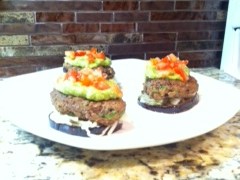
As the burgers near ready, spread a thin layer of your fermented, non-pasteurized sauerkraut on the eggplant.  Place the burger on top and cover with your delicious guac (or simply sliced avocados if you’re lazy…I mean pressed for time) and diced tomatoes.

And there it is; healthy classic treat without the dairy, grains or pro-inflammatory Omega 6s.

(If you LOVE picking your burger up and eating with your hands, feel free to cut the eggplant thicker and double the amount so you can close that bad boy up and enjoy the meal mentally as well.)

photo 2